
The Current Landscape of Gluten-Free Food Labeling
Food labeling policy relevant to people with celiac disease has moved quickly in the last few months. Three bills are active in Congress, and international precautionary allergen labeling guidance now includes gluten. This update walks through each policy, where the Society for the Study of Celiac Disease (SSCD) stands, and why, so you have what you need to explain our position to colleagues and patients.
The Problem
Under current U.S. law, of all gluten-containing grains, only wheat is designated a major food allergen, which triggers the clear, plain language “Contains” labeling on food packaging. Barley and rye are not classified this way. This leaves patients often having to hunt for terms like “malted barley extract” or “rye flour” in ingredient lists. Australia, New Zealand, Canada, the UK, and all 27 EU member states already require gluten-containing grains to be labeled as major allergens, but the U.S. falls behind in this regard.
Three bills currently in Congress aim to address this gap.
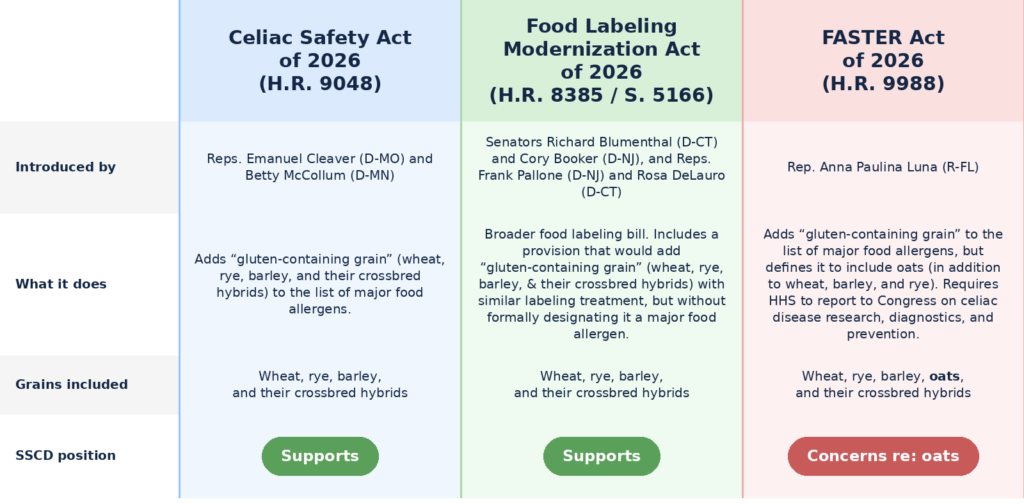
The Celiac Safety Act of 2026 (H.R. 9048)
Introduced May 29, 2026, by Representatives Emanuel Cleaver (D-MO) and Betty McCollum (D-MN), the Celiac Safety Act would amend the Federal Food, Drug, and Cosmetic Act to add “gluten-containing grain” (defined as wheat, rye, barley, and their crossbred hybrids) to the list of major food allergens. The definition of gluten-containing grains used in this bill matches both the FDA’s existing gluten-free labeling regulation and the FAO/WHO Codex Alimentarius definition, so it wouldn’t create a new, conflicting definition.
In practice, this means any product containing wheat, barley, or rye would need a clear “Contains” statement; the same way milk or peanuts are disclosed today. Manufacturers would have an 18-month window to comply.
Why SSCD supports it: This bill would be transformative for the millions of Americans with celiac disease, making it substantially easier to understand what food is safe or unsafe to eat. It uses a definition of gluten-containing grains that is evidence-based and aligns with pre-existing definitions. It’s also narrowly scoped, which matters for how quickly a bill can realistically move through Congress.
For more information on the Celiac Safety Act, see the Celiac Disease Foundation’s webpage on the bill.
The Food Labeling Modernization Act of 2026 (H.R. 8385/S. 5166)
The Food Labeling Modernization Act of 2026 is a much broader bill covering many aspects of food labeling. Included in it is a provision that would add “gluten-containing grain” (using the same wheat/rye/barley/hybrids definition as the Celiac Safety Act) alongside major allergens, giving it much of the same practical labeling treatment as the other two bills without formally designating it a major food allergen.
How this relates to the Celiac Safety Act: SSCD supports both these bills; they are not in competition. The Food Labeling Modernization Act is a different kind of legislative vehicle that could move on a different timeline than the condensed Celiac Safety Act. Supporting both increases the odds that gluten labeling improves through whichever path advances first.
The FASTER Act of 2026 (H.R. 9988)
Introduced July 30, 2026, by Representative Anna Paulina Luna (R-FL), the FASTER Act of 2026 would take the same basic approach as the Celiac Safety Act of adding gluten-containing grains as a major food allergen, but its definition of gluten-containing grains also includes oats. Doing this would reclassify oats as a gluten-containing grain, when oats inherently do not contain gluten. It additionally requires HHS to report to Congress on celiac disease research, diagnostics, and prevention, and gives manufacturers a one-year window to comply.
Why SSCD does not support classifying oats this way: Oats are botanically and biochemically distinct from wheat, barley, and rye as they don’t naturally contain the same proteins that drive the celiac disease immune response. Most people with celiac disease can safely tolerate pure, uncontaminated oats; only a minority react to oats’ own protein avenin. The real risk with oats isn’t the grain itself, but with the cross-contact during growing, harvesting, and processing. That’s a supply-chain and cross-contact problem, not a reason to declare oats inherently unsafe the same way wheat, barley, and rye are. Classifying oats as a major allergen would unnecessarily restrict a food that’s safe and valuable for most celiac disease patients, and risks diluting the label’s clarity for the grains which are the core concern.
For a side-by-side comparison of all three bills, see Allergic Living’s coverage.
New Codex Guidance on “May Contain” Labeling
In addition to the potential improvements in allergen statements listed above, this year we’ve seen advancements in guidance for precautionary allergen labeling (PAL). In July 2026, the FAO/WHO Codex Alimentarius Commission adopted new guidance on PAL, the “may contain” statements found on many packaged foods, to now include gluten.
For the first time, there is now a reference dose for gluten (4 mg). Previously, of all gluten-containing grains, there had only been a reference dose for wheat using science from wheat allergy. This matters because people with celiac disease can be impacted by cumulative, long-term gluten exposure from wheat, barley, and rye combined, not just an acute reaction to wheat protein alone. The new reference dose lets manufacturers assess “may contain” risk using science that actually reflects celiac disease.
Importantly, this is not a new gluten-free threshold; foods labeled “gluten-free” must still contain less than 20 ppm of gluten.
The U.S. doesn’t currently have a formal PAL framework, with “may contain” statements here being voluntary and unregulated. However, this Codex update gives U.S. regulators a science-based model to point to if and when the FDA takes up precautionary labeling.
For more information on this updated Codex guidance, see the Celiac Disease Foundation’s blog post.
What You Can Do
Both the Celiac Safety Act and the Food Labeling Modernization Act need congressional support to advance. Please contact your representatives and urge them to co-sponsor this legislation and share this with colleagues and patients who may want to take action too.
Canada
Health Canada is modernizing the Food and Drug Regulations (FDR). The specific sections are Division 24 and 25 which includes Foods for Special Dietary Use in Division 24 where the gluten-free regulation is located. Celiac Canada (CCA) has been in discussions with key staff in the Food and Nutrition Directorate at Health Canada for the past 2 years, advocating for improved and enhanced gluten-free regulations. Stay tuned for an update on progress. In the meantime, the current Canadian FDR requires that the major allergens and all gluten-containing grains be declared in the ingredient list or in a Contains statement immediately following the ingredient list.
Article updated on October, 2026